The long game:
Mars 14k2053
The mission of Costrum is to accelerate humanity's transition into a multi-planetary species. A 14,000-person, maximally self-sustaining colony on Mars by 2053
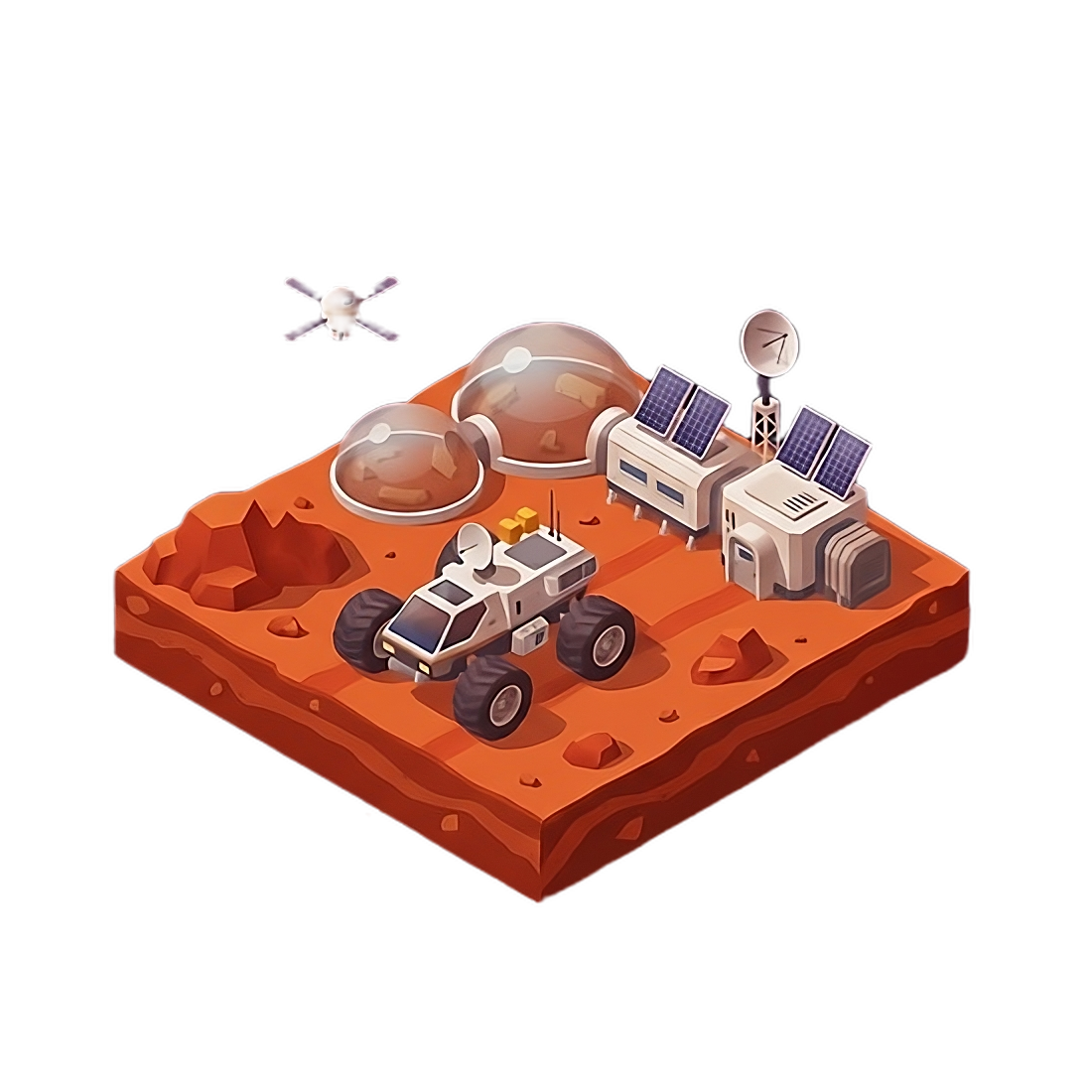
Why do we need a second planet?
Why not focus on taking care of the Earth?
Making life multi planetary is a condition for long-term survival and for guaranteeing a beautiful future for our children. It has te be done.
Maximizing the chance for a beautiful future
Nearly 100% energy on Earth comes from the Sun (coal & oil as well - it's just accumulator), and on orbit and beyond you unlock access to more energy we'll ever need. "it is always sunny in orbit". You can use this energy to power industry, to decarbonise atmosphere, to make many other things possible. There's so much more beyond just (nearly) free power - moving heavy industry into orbit and turning Earth into a garden planet. Utilizing unlimited energy from the sun Space mining- key raw materials, including gold, are abundant in asteroid belt next to Mars.
Where are the dinosaurs?
Can you guarantee that nuclear war / asteroid or a number of other extinction-level threats won't end this chaotic yet interesting phenomena we call life? Well, yes, you can. But only if not everyone and everything is in once place. t's just a math - we are likely the first species on Earth that's quite capable of extincting ourselves, and our capabilities only accelerate. But even if we couldn't, problem is not solved - the dinosaurs were kings of this planet for millions of years. Until they hit extinction-level event. It's a math - I don't waste time guessing which scenario and when, but some will eventually happen. Colonizing other planets (end later - other star systems) is the only guarantee of long-term survival of life. If the life is gone, nothing else matters. We are the only species on this planet capable of doing so, and we will solve this problem for everyone. We will take plants and animals with us.
Development of the technologies we need for Earth
The center of the Sahara or the peak of Everest are paradise compared to Mars. The technologies we develop for Mars will help us solve many of Earth's current problems. Even if really awesome scenarios can take some time, while we solve Mars we'd get very quick return on investment in influx of new solutions for our old problems.
-1.png) Mars Image Placeholder
Mars Image Placeholder"Impossible. You'll never make it, even in 100 years"
In our opinion, the flight to the Moon in 1969 was more difficult than colonizing Mars today. No one knew if the human body could survive a flight into space; all technology was prototypical. The average modern smartphone has a processor 100,000 times more powerful than the Apollo Guidance Computer (AGC). Artificial intelligence was only in its infancy. Today? Our robots are currently operating on Mars. Starship is the final technological breakthrough we are missing (mass, low-cost transport). The rest is just a series of specific engineering tasks – the final puzzle pieces to be assembled.
Costrum’s Role
Costrum is founded on base hypothesis: there's no way to guarantee good futures and minimize risk for no future for our children other than making life multi planetary, so we need to do whatever is needed to get it done. We did all we could to negatively verify this hypothesis. We've run multiple scenarios, had discussions with experts from most of world leading space agencies - both governmental and independent. Talked with planetary defense experts to make sure nobody found the solution. What we've learned, just made us hurrying up more.
From the Wright brothers' first wooden airplane in 1903 to the Moon landing, only 66 years passed.
Entering the interplanetary era within our lifetime does not break the laws of physics. It is not impossible.
We do not need any groundbreaking scientific discovery. We need courage, money, and to refine existing technologies.
Costrum team obviously won't build Mars colonies by ourselves. We have specific problem to solve.
CostrumAI is an economic engine that will provide secure, independent funding for the long term projects. For Mars 14k2053, we need talent, money, and coordination. In large quantities. Our roadmap is laid out for 30 years, with milestones and measurable goals. We assume that the minimum scale Costrum must reach to complete the task is $100M ARR (annual recurring revenue), with a minimum of 10% of revenue (>$10M per year) invested in Mars, excluding other investors (private and institutional).
First, the flight to Mars will need to be possible. Then, as we solve more problems, it will become relatively safe. Then, relatively cheap. At some point, comfortable. It's just a function of many solved problems and deploying solutions on industrial scale. Who would believed 150 years ago, that humans will casually fly to other continent and be back next day?
We really don't care who's flag will be the first - go put there yours, that's fine. What matters is not a single event, but a ecosystem growing at a scale. We need probably cargo transport between Earth and Mars in the order of megaton, and Mars economy and science as magnet for smartest and most determined humans.
It’s difficult. But not "impossible." OpenAI was founded 10 years ago (2016), Google 27 years ago. From today until 2053, we have 27 years left, and the Costrum team is working at the pace of an ammunition factory in a besieged city. Labor omnia vincit.
Incubator for 1000 startups
Beyond Starship, there will be a mass of technical problems left to solve. Humanity’s most effective tool for solving complex technical problems is deep tech startups. Costrum will not build a city on Mars alone. But Costrum + 1000 startups, many of which will grow into globally operating companies like SpaceX - that is realistic. They will receive from us funding, know-how, ready-made contract packages, and access to top engineers who also believe in Mars. And CostrumAI - we are building it from the start as a ready-made tool for the founders of these startups, which will help them with engineering and sales.
Costrum Academy
At its peak, the Apollo program employed 500,000 people, including public administration and industry. Assuming that, by operating much more efficiently than large government programs, it is enough to recruit and train about 50,000 of the top 1% of engineers available on Earth. The Costrum Academy will be a forge for the personnel of 1,000 startups in the Incubator.
Money & Ecosystem
We will personally select, fund and mentor everyone in Mars incubator. And we will connect every new founder with their senior peers, who will be their first customers and mentors. This is how the best incubators, like Y Combinator, work – beyond the money, you get customers, a community, and access to the invaluable know-how of people who have been through all the problems you are facing right now.
Earth is great, but how can you spend your whole life on one planet?